Sunday, January 11, 2015

Article of the year

I read this and had to pass it along.

http://oliverdemille.com/2014/12/article-year/

The Best…
3 economies 2 258x300 The Article of the Year!Last week Rachel asked me if I was going to write a “best books of the year” article like I have the last few years. “I’m not sure,” I sighed. “To tell the truth, I think it’s getting a little old. I see ‘best books,’ ‘best movies,’ ‘best albums,’ of the year, etc. in most of the national magazines and newspapers each year. In fact, I just recently read a December issue of a magazine that listed the ‘5 best of the year’ in all these categories. I think it’s a bit overdone these days.”
“That makes sense,” she responded. “But the end of the year is a profound time to look back and note important things that have happened. It’s natural, and it is good for us.” She pondered for a minute, then said enthusiastically, “What about a ‘best article of the year?’ Is there an article you wrote this year that you think is the most important one? Something everyone in America and beyond really needs to read?”
I immediately brightened and sat forward in my seat. “Yes!” I said. “There’s one article I wrote that I wish I could send out every week, over and over. I wish every person in North America would read it! And Europe, and beyond. It’s that important.”
“What is it?”
Well, here it is. The “Article of the Year!” If you read it before when it came out, please, please read it again. It’s that powerful. It’s that important. And if you haven’t read it before, now is the time.
The message of this article is extremely important! If you have children or grandchildren who will live, seek an education, and work in the next thirty years, the information in this article is vital. Absolutely vital. If you or your spouse will work in the next year, or three years, or ten years, the knowledge in this article is essential. This is an article on education, on leadership, and on the economy. Nobody should have to face the economy ahead without knowing what’s in this article! Read it! Enjoy it! Share it!
Here goes:

A Tale of Two

There are three economies in modern society. They all matter. But most people only know about two of them. They know the third exists, in a shadowy, behind-the-scenes way that confuses most people. But the first two economies are present, pressing, obvious. So people just focus on these two.
A couple of recent conversations brought these economies even more to the forefront of my thinking. First, I was meeting with an old friend, touching base about the years since we’d talked together. He mentioned that his oldest son is now in college, and how excited he is for his son’s future. I asked what he meant, and he told me an interesting story.
Over twenty years ago he ran into another of our high school friends while he was walking into his community college administration building. The two greeted each other, and they started talking. My friend told his buddy that he was there to dis-enroll from school. “I just can’t take this anymore,” he told him. “College is getting me nowhere.”
“Well, I disagree,” his buddy said. “I’m here to change my major. I’m going to get a teaching credential and teach high school. I want a steady job with good benefits.”
Fast forward almost thirty years. My friend ran into this same old buddy a few weeks ago, and asked him what he’s doing. “Teaching high school,” he replied.
“Really? Well, you told me that was your plan. I guess you made it happen. How much are you making, if you don’t mind me asking?”
When his friend looked at him strangely, he laughed and said, “I only ask because you told me you wanted a steady job with good benefits, and I wanted to get out of school and get on with real life. Well, I quit school that day, but I’m still working in a dead end job. Sometimes I wonder what I’d be making if I had followed you into the admin building that day and changed majors with you.”
After a little more coaxing, the friend noted that he didn’t make much teaching, only about $40,000 a year—even with tenure and almost thirty years of seniority. “But it’s steady work, like I hoped. Still, I’ve got way too much debt.”
After telling me this story, my old high school friend looked at me with what can only be described as slightly haunted eyes. “When he told me he makes $40K a year, I just wanted to scream,” my friend said.
“Why?” I asked.
He could tell I didn’t get what he was talking about, so he sighed and looked me right in the eyes. “I’ve worked 40 to 60 hour weeks every month since I walked off that campus,” he told me. “And last year I made about $18,000 working for what amounts to less than minimum wage in a convenience store. I should have stayed in college.”
That’s the two economies. One goes to college, works mostly in white-collar settings, and makes from thirty thousand a year up to about seventy thousand. Some members of this group go on to professional training and make a bit more. The other group, the second economy, makes significantly less than $50,000 a year, often half or a third of this amount, and frequently wishes it had made different educational choices.
The people in these two economies look at each other strangely, a bit distrustfully, wondering what “could have been” if they’d taken the other path. That’s the tale of two economies.
Most people understand the first two economies, but the Third Economy is elusive for most people. They don’t quite grasp it. In fact, you may be wondering what I’m talking about right now.
The Third Economy
This brings me to our main point. Ask members of either economy for advice about education and work, and they’ll mostly say the same thing. “Get good grades, go to college, get a good career. Use your educational years to set yourself up for a steady job with good benefits.” This is the advice my grandfather gave my father at age twenty, and the same counsel my dad gave me after high school. Millions of fathers and mothers have supplied the same recommendations over the past fifty years.
This advice makes sense if all you know are the two economies. Sadly, the third economy is seldom mentioned. It is, in fact, patently ignored in most families. Or it is quickly discounted if anyone is bold enough to bring it up.
3 economies 1 290x300 The Article of the Year!A second experience illustrates this reality. I recently visited the optometrist to get a new prescription for glasses. During the small talk, he mentioned that his younger grandchildren are in college, but scoffed that it was probably a total waste of time. “All their older siblings and cousins are college graduates,” he said, “and none of them have jobs. They’ve all had to move back home with their parents.”
He laughed, but he seemed more frustrated than amused. “It’s the current economy,” he continued. “This presidential administration has been a disaster, and it doesn’t look like anyone is going to change things anytime soon. I don’t know what these kids are supposed to do. They have good degrees—law, accounting, engineering—but they can’t find jobs. Washington has really screwed us up.”
I brought up the third economy, though I didn’t call it that. What I actually said was: “There are lots of opportunities in entrepreneurship and building a business right now.” He looked at me like I was crazy. Like maybe I had three heads or something. He shook his head skeptically.
“Entrepreneurship is hard work,” I started to say, “but the rewards of success are high and…”
He cut me off. Not rudely, but like he hadn’t really heard me. That happens a lot when you bring up the third economy.
“No,” he assured me, “college is the best bet. There’s really no other way.”
I wasn’t in the mood to argue with him, so I let it go. But he cocked his head to one side in thought and said, slowly, “Although…” Then he shook his head like he was discounting some thought and had decided not to finish his sentence.
“What?” I asked. “You looked like you wanted to say something.”
“Well,” he paused…then sighed. I kept looking at him, waiting, so he said, “The truth is that one of my grandsons didn’t go to college.” He said it with embarrassment. “Actually, he started school, but then dropped out in his second year. We were all really worried about him.”
He paused again, and looked at me a bit strangely. I could tell he wanted to say more, but wasn’t quite sure how to go about it.
“What happened?” I prompted.

What Really Works

“To tell you the truth, I’m not really sure. He started a business. You know, one of those sales programs where you build a big group and they buy from you month after month. Anyway, he’s really doing well. He paid off his big house a few years ago—no more mortgage or anything. He has nice cars, all paid for. And they travel a lot, just for fun. They fly chartered, real fancy. He and his wife took us and his parents to Hawaii for a week. He didn’t even blink at the expense.”
“That’s great,” I told him. “At least some people are doing well in this economy.”
He looked at me with that strange expression again. “I’m not sure what to make of it,” he said. “I keep wondering if he’s going to finish college.”
I was surprised by this turn of thought, so I asked, “So he can get a great education, you mean? Read the classics? Broaden his thinking?”
He repeated the three heads look. “No. He reads all the time, way more than anyone else in the family. He doesn’t need college for that. I want him to go back to college so he can get a real job.”
I laughed out loud. A deep belly laugh, it was so funny. I didn’t mean to, and I immediately worried that I would offend him, but he grinned. Then he shook his head. “I know it’s crazy, but I just keep worrying about him even though he’s the only one in the family who is really doing well. The others are struggling, all moved back in with their parents—spouses and little kids all in tow. But they have college degrees, so I keep thinking they’ll be fine. But they’re not. They’re drowning in student debt and a bunch of other debts. It just makes no sense.”
He sighed and talked bad about Washington again. Finally he said, “I’ve poured so much money into helping those kids go to college, and now the only one who has any money to raise his family is the one who dropped out. It just doesn’t make any sense.” He kept shaking his head, brow deeply furrowed.
I left his office thinking that he’s so steeped in the two economies he just doesn’t really believe the third economy exists. He just doesn’t buy it, even when all the evidence is right there in front of him. The whole economy has changed. It’s not your father’s or grandfather’s economy anymore. It just isn’t. Sadly, he just doesn’t get that the reality has changed.

Who Gets It

He’s not alone. The whole nation—most of today’s industrialized nations, in fact—are right there with him. So many people believe in the two economies, high school/blue collar jobs on the one hand, and college/white collar careers on the other. Most people just never quite accept that the entrepreneurial economy is real. They don’t realize that there are many less white collar jobs per capita now, and that this trend shows all the signs of increasing. They don’t admit the truth, that over half of college grads in recent years can’t find jobs, and a huge number of those with degrees and without degrees are moving back home just to survive. But the third economy is flourishing.
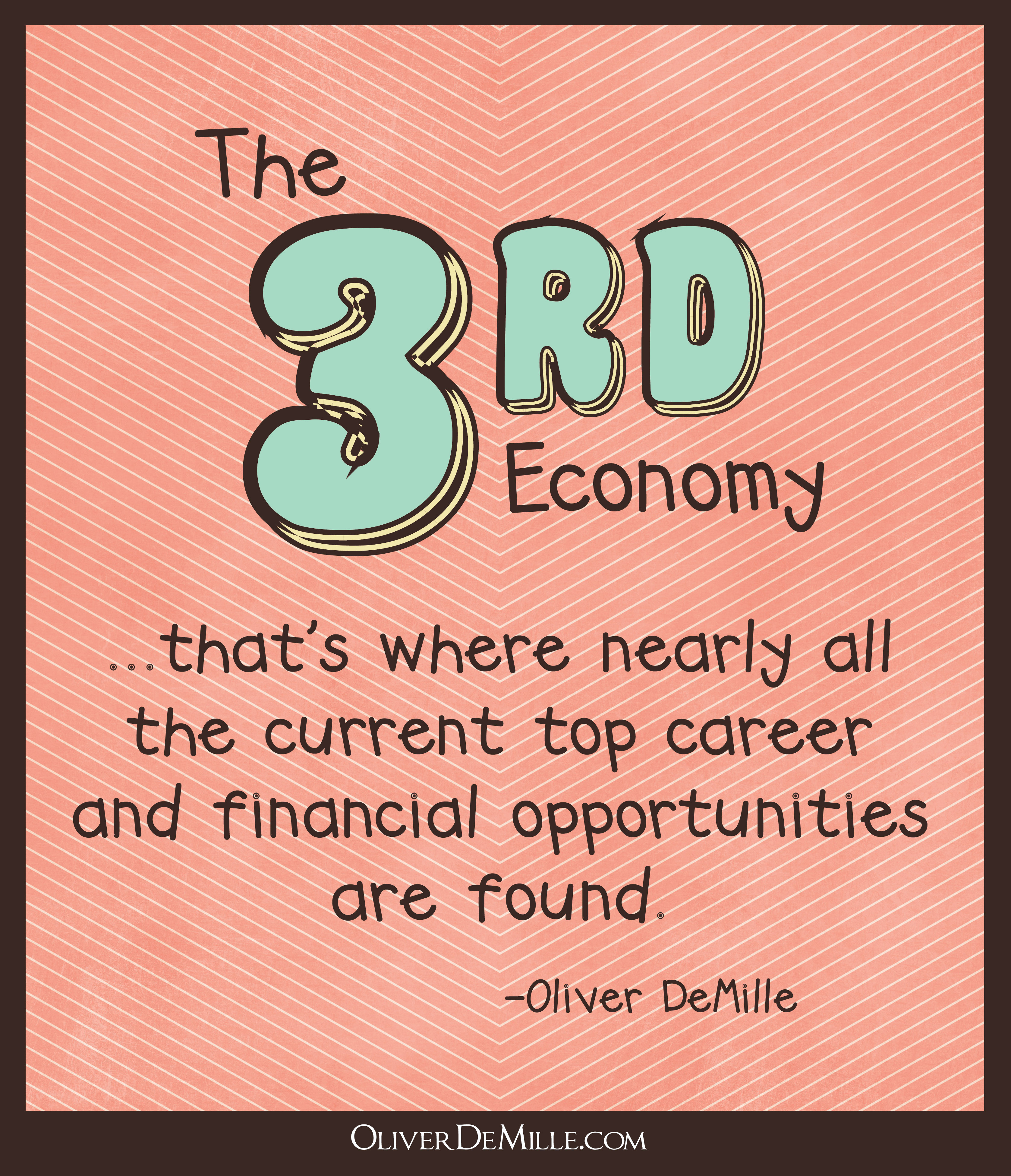
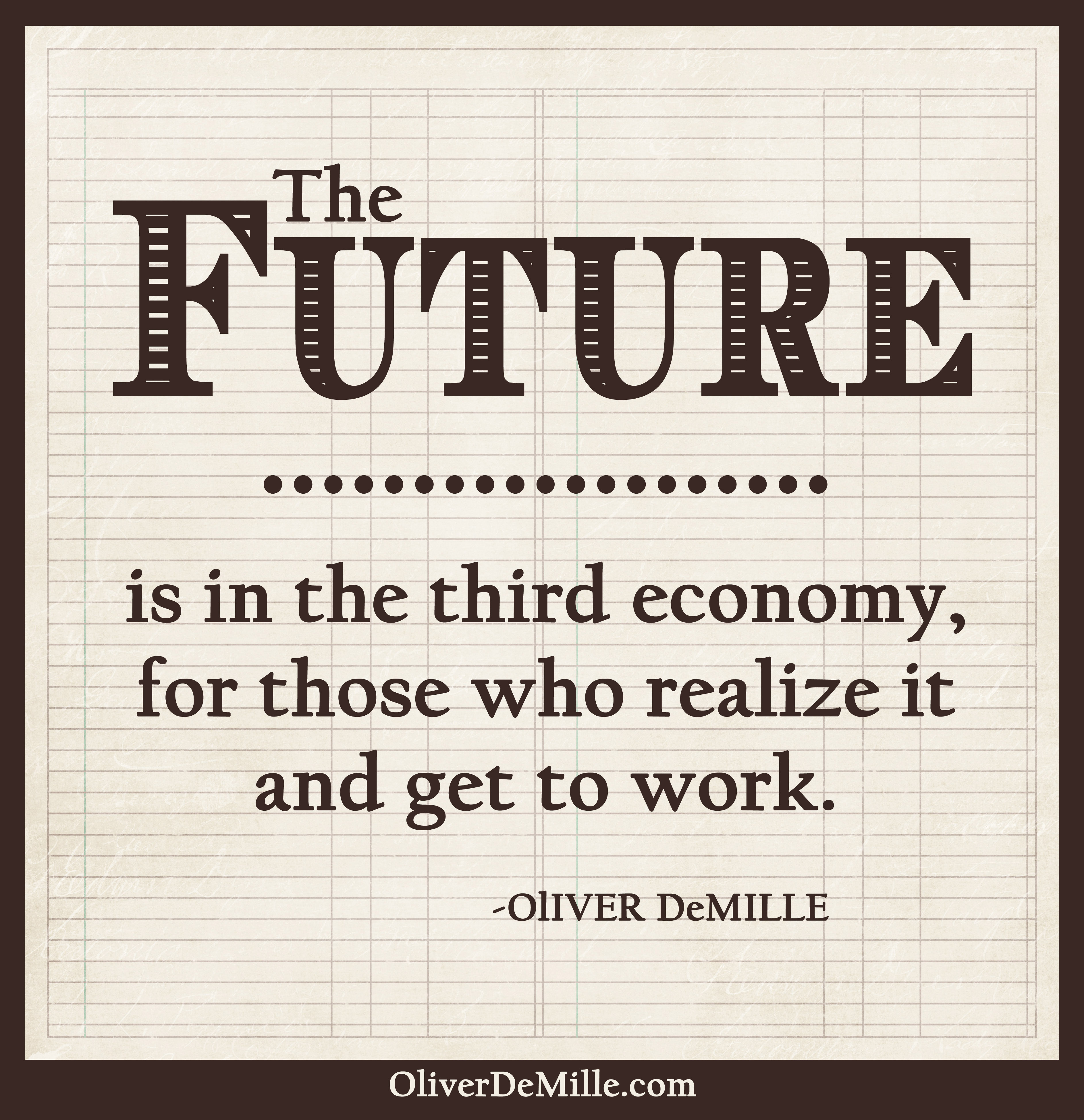
It’s too bad so many people won’t admit this, because that’s where nearly all the current top career and financial opportunities are found. The future is in the third economy, for those who realize it and get to work. If you’ve got kids, I hope you can see the third economy—for their sake. Because it’s real, and it’s here to stay. The first two economies are in major decline, whatever the so-called experts claim. Alvin Toffler warned us in his bestseller FutureShock that this was going to happen, and so did Peter Drucker, back when they first predicted the Information Age. Now it’s happening.
I hope more of us realize the truth before it’s too late. Because China gets it. So does India, and a bunch of other nations. The longer we take to get real and start leading in the entrepreneurial/innovative third economy (the real economy, actually), the harder it will be for our kids and grandkids. The third economy will dominate the twenty-first century. It already is, in fact. Whether you’ve chosen to see it yet or not. This is real. This is happening. This is the future. This is the current reality.
Truth is truth, even when our false traditions and outdated background refuse to let us see clearly. The parents who see this, embrace it, and help their kids prepare to take action in the third economy are providing a real education for their family. Everyone else…isn’t.

Friday, December 26, 2014

Another year gone.....

It's now after Christmas, and I think it is time to write down what has happened this year.  It has been quite the year, with joyful moments and some not so joyful moments.  Being an adult is not all that I thought it would be growing up, but this year has been an amazing journey.

My year really began late last year, as I was married to my best friend, Cathy.  We began the year coming back to Logan from our honeymoon to Las Vegas.  Once we got back, Cathy began looking for a job.  She found two, and spent the first 2 months of our married extremely busy.

In February we found out we were expecting a baby, which was one of the happiest moments in my life.  I was going to be a father!  Cathy and I were both extremely excited!  After finding this out, Cathy quit one job.  She was very sick the first trimester of the pregnancy, and it was a rough time for both of us.

Once spring hit, life improved.  I do not really like the first two months of the year.  They are both kinda depressing.  But spring came, and life for the Summits was good once again.  I was almost done with my Associates degree from Salt Lake Community College, and I attended the graduation center at the Maverick Center in Salt Lake.  It was fun, but I have no desire to go to any more graduations for myself.

This past summer was difficult for us.  We attended my mission President's homecoming talk in Highland, and that was a blast.  Later that night, we took Cathy to the hospital where we found out that her body had went into pre-term labor, and she was dilated to a 3 at 28 weeks in her pregnancy.

Cathy was life flighted to Ogden, where she spent the next 4 weeks sitting around, trying not to have our baby.  This time was hard, because I was working in Logan, commuting to Ogden as often as possible, and trying to finish my degree.  I had 3 classes I had to pass, and one was a statistics class, which I was struggling in.  Thankfully, I was able to pass and get my degree.

September was really fun. Cathy was home now, but on modified bed rest.  But, we didn't really follow this advice.  We went swing dancing, walking up Old Main Hill, went to Salt Lake, and lived our lives.  We both wanted the baby to come, and figured when it came, it came.  Both of our birthday's are in September, and we had a lot of fun.

In October, Allison Marie joined our little family.  She has been a huge blessing. I love going home and being with my two girls.  I love them both dearly.  Allison is growing, and is very beautiful.  I never understood how fathers could say that their daughters are the most beautiful thing in the world until I became a dad. I don't want to brag, but my daughter is the most beautiful daughter in the world!

Cathy and I have enjoyed being new parents, dirty diapers and less sleep aside.  Allison is so much fun, we love it when she smiles.  She is learning how, so this happens frequently.  She has grown up to be such a cute little girl.  She has a ton of dark hair, and she looks so much older than other babies.

This holiday season has been one to remember.  Cathy made most of the gifts we gave on Christmas, and we enjoyed being with family.  We are very blessed having both families so close to us.  This year has been an adventure, and next year will be as well!

Wednesday, December 10, 2014

Why married people can't have friends

http://www.millennialmormons.com/married-people-cant-friends/

I completely agree with this article.  I know from experience marriage is great.  It is important to put those in your family before others, including friends from high school.  But I do think it is important to maintain friendships with those friends for as long as possible.  I honestly miss spending time with my high school buddies, and have once in a while.

My wife and little daughter bring me the most happiness, and I love spending time with them.  Looking at my little girl always brings a smile to my face, and helps me see that life is great, after all my worries and struggles.

My wife is beautiful, and I love her.  She is my best friend, the person I confide in and share intimidate thoughts with.  I don't know where I'd be without her and her support.  Her happiness is much more important than mine.

While spending the majority of time with my family, I do believe that it is OK for me to do a few things with friends.  I have had several parties where I invite friends and we play games and reconnect.  It is so much fun to see where they are all at, and to share with them experiences I've had.  Friendships are important, and they may suffer because I am married.  But there is no excuse to end them.

Saturday, December 6, 2014

The One Question Every Parent Should Quit Asking

The One Question Every Parent Should Quit Asking


"It's like she's not even practicing."

Audrey's piano teacher was standing in front of me, giving her honest assessment. Her eyes were kind, and her voice soft, but my parental guilt turned her statement into a question. One I couldn't answer. So I just faked a diarrhea attack and ran to the restroom.

Once we got home, I was determined to show Miss Amanda that my daughter could be the next Liberace, only more bedazzled than the original. So we opened her music book and got to work.

We sat side-by-side at the piano for all of 10 minutes when Audrey began to fade. She wasn't even looking at the notes. Her back slouched. Her fingers barely pressed the keys. I tried to be encouraging, but every half-hearted effort from her quickly depleted my well of schmoopieness.

"Sweetheart," I said, in a tone that didn't match the pet name. "Don't you want to be good at this?"

She didn't say anything. She just made a weird sound. Like a dolphin moaning. So I asked again.

"Honey. Don't you want to be good at piano?"

"No." She answered, with a look.

Has my 6-year-old mastered the art of spitefulness?

"Fine," I said, calling her bluff. "I guess we just won't practice anymore. And we'll keep wasting Miss Amanda's time going over the same things every week."

I got up and walked to the kitchen where my son was busy not doing his homework.

"Jake! What are you doing?! Finish your homework! We have to leave for basketball practice in 10 minutes! Let's go! You're not even dressed!"

Not my best parenting moment. The entire evening went on like this, with me incessantly jabbing at the kids and them fighting me every step of the way. Piano. Basketball. Homework. Hygiene. Lather, rinse, repeat. A never-ending well of cajoling. I thought to myself,

They are both getting saddles for Christmas. That way, at least I'll be comfortable when I'm riding their asses all the time.

I am not proud of it, but the simple truth is that I worry about my kids and their level of engagement. And maybe you do, too. As a dad, I frequently feel myself getting sucked into the vortex of expectations. All the other parents are talking about great opportunities they are providing for their kids. Special summer camps. Foreign language learning. Private tutors. Music lessons. Coaching clinics. And when I hear how other kids are participating in these activities, I can't help but feel that my children will be left behind or left out if they don't take part. I "awfulize" a future where other kids are having fun together, solving quadratic equations and getting six-figure jobs out of junior high while mine are both sitting in the corner eating Elmer's Glue straight from the bottle.

And it's all my fault.

So, in an effort to prepare our kids for the dog-eat-dog, competitive world before them, we fill their days with activity. Schedule them from dawn to dusk to maximize their potential. So they can learn. And grow.

But I fear that in our quest to help them, we may actually be hurting them.

"Free time" for kids has been steadily declining since the 1950s. In one particular study, from 1981 to 1997, kids experienced a 25 percent decrease in play time and a 55 percent decrease in time talking with others at home. In contrast, time spent on homework increased by 145 percent, and time spent shopping with parents increased by 168 percent.

But is that bad?

I think it is.

A research project by Jean Twenge, professor of psychology at San Diego State, looked at psychological trends in youth during a similar period and noticed a sharp increase in anxiety and depression. Our kids are more stressed out than before. And that's not the only change. Another Twenge study shows a surprising shift in motivation over the years, with kids in the 60s and 70s reporting being more motivated by intrinsic ideals (self-acceptance, affiliation and community) while kids today are more motivated by extrinsic ideals (money, image and fame).

And we're the ones pushing them in that direction.

As parents, we focus 100 percent of our energy asking the wrong question:

"What might we miss if we don't take advantage of these opportunities?"

And we need to stop.

Why?

Because the motivation behind this question is fear. And the fear is all mine.

I worry that that my kids will be made fun of if they don't have socially acceptable "stuff." I worry they won't become elite athletes unless they specialize in a sport by age 10. I worry that they won't get into college if they don't do well in school.

But the fears are largely unfounded.

The "stuff" issue is easily overcome with common sense. No one in the history of the world has ever been able to buy a true friend. And in the athletic realm, kids who specialize in sports are no better off than those who don't, and in some cases, thespecialization is actually a detriment.

As for the academic worry, that may be the biggest unfounded fear of all. We buy into the hype that college is much more competitive today, so we push our kids to take advantage of every learning opportunity under the sun. The truth is, in the past 10 years, admissions counselors saw their average number of applications nearly double because of parents like us. We're frantically submitting applications out of fear. Even so, colleges are still accepting two-thirds of all applicants on average. A number that has hardly decreased in a decade.

But we still believe the hype.

Bottom line: we parents need to chill out and change our questions. Here are two that can help us all gain some perspective and start finding more genuine joy in our lives.

Question #1: "What are we losing in our quest for success?"

If you are like me, most valuable parts of your childhood did not take place in a special classroom or perfect practice field. Sure, you had teachers and parents to encourage you to do your best and work toward a goal, but that was balanced by plenty of other worthwhile pursuits such as tearing apart a Stretch Armstrong doll to see what was inside, building bike ramps in the driveway, and racing leaf boats through a drainage ditch in a rainstorm.

But we've sacrificed these things in pursuit of an ideal, and we've turned our children into little mini-adults in the process. Tiny professionals who have no time for brain-building, soul-boosting play during the week, so they desperately cram it into a weekend schedule packed with structured sports and recitals.

It's sad.

But the bigger issue is this:

Question #2: "What's the ultimate goal?"

Encouraging a child's potential is a good thing. And there is nothing wrong with extracurricular activities. They teach worthwhile skills and instill core values in a child. Values such as discipline, commitment, goal-setting, and persistence. And providing these opportunities is my job as a parent.

But there is a big difference between wanting what's best for your kids, and wanting them to be the best.

Wanting what's best for your kids is all about the child. It's about helping them find something they are passionate about so they are intrinsically driven to reveal the strengths that God gave them, whether in art, music, sports, writing, academics, or community service.

Wanting them to be the best is all about me. My expectations. My fears. So I yell at them from the stands, correct them after lessons, and coax them into activities that suck the fun out of childhood. And in the process, I teach them that their worth is wrapped up in how they perform. I teach them that second place is losing. I teach them that judgment is more important than love and acceptance.

And it is so wrong.

Because being the best should NOT be the goal. If I asked you to name the last five winners of the Academy Award for best actor, could you do it? How about the last five World Series winning pitchers? Last five Nobel Prize winners in medicine? I'd venture to guess, based on absolutely no scientific evidence, that only 10 percent of you could do it. At the most. And these are examples of people who have achieved the pinnacle of their profession. Known the world over.

And we forget them.

But what if I were to ask you to list the five people who have meant the most to you in your life? The ones who taught you what it means to be a true friend. A person of integrity. I know without a doubt that 100 percent of us could do it in a heartbeat. And the list would be filled with people who never had a highway or high school named after them. People who never had their name carved on a ceremonial trophy.

But here's the kicker.

The mere thought of their faces likely makes your heart swell. Might even bring a tear to your eye.

And this, my friends, is the goal. To be on the list for our kids. So that they might be on someone else's list someday. And no amount of fear and anxious prodding will accomplish that for us. In this constantly correcting, constantly evaluating world, there has to be space for acceptance. Space for presence. Space where time isn't measured in tenths of a second, but in turns taken on a colorful Candy Land board.

And only love can do that.

So my prayer today is that we have nothing but love to give. May we offer it daily.

Without condition.

Without worry.

Without regret.

Scott Dannemiller is a writer, blogger, worship leader and former missionary with the Presbyterian Church. He writes the blog The Accidental Missionary, where this post first appeared.
http://www.huffingtonpost.com/scott-dannemiller/the-one-question-every-parent-should-quit-asking_b_6182248.html 

Tuesday, December 2, 2014

King of England

http://www.bbc.com/news/science-environment-30281333

This is an interesting article that showed up on my Facebook "trending" section.  I thought it was interesting how the article talks about how some members of the royal family may not be royal after all.  All because someone 14 or 15 generations back was promiscuous.

The lesson I take from this is that people need to be committed in a marriage, because you never know what your 14th great grandchild will find out about you!

Saturday, November 29, 2014

books this year

Book of Mormon Sleuths: The Forgotten Treasure by C. B. Anderson
Book of Mormon Sleuths: The Lost Tribe by C. B. Anderson
Book of Mormon Sleuths: The Hidden Path by C. B. Anderson
7 seconds or less by Jack McCallum
Banner in the Sky James Ramsey Ullman
Last of the Breed Louis L'Amour
Tennis Shoes Among the Nephites book 12 Drums of Desolation by Chris Heimerdinger
I'd tell you I love you, but then I'd have to kill you (Gallagher Girls, #1) by Ally Carter
Cross My Heart and Hope to Spy (Gallagher Girls, #2) by Ally Carter
Don't Judge a Girl by Her Cover (Gallagher Girls, #3) by Ally Carter
Only the Good Spy Young (Gallagher Girls, #4) by Ally Carter
Classified Material (Gallagher Girls, #4.5) by Ally Carter
Out of Sight, Out of Time (Gallagher Girls, #5) by Ally Carter
United We Spy (Gallagher Girls, #6) by Ally Carter
Ever by Gail Carson Lavine


Tuesday, November 25, 2014

Christmas

So now that it is almost Thanksgiving, there has been a lot of articles posted and talked about on the social media platform I use most often: Facebook.  I just read an article written by someone who has worked in retail for years.  The author writes about how he hated the holiday shopping season because of how much he worked, and how people treated him.

Having gone Black Friday shopping in years past, I have seen people behave differently as part of the shopping mob than they would if they weren't so worried about pleasing their kids with the best things for Christmas.  Honestly,  why do parents worry about getting a game system 2 years after they bought one?  Kids do NOT need everything electronic gadget there is.  I have seen a 10 year old with cell phone and tablet.  I am 23 and don't have a tablet, and I am perfectly happy!  Besides, growing up, there were few Christmas presents that I have kept from longer than a few months.  The only one I can think of is my stuffed animal, Stuart.  He was my favorite stuffed animal until I was about 15.

Sometimes when I am shopping, I can be in a hurry to get somewhere.  And on Black Friday, I think a lot of people are hurrying from one store to the next.  I know that stores try to stagger their opening times to get the most shoppers in the store as possible.  So people rush from place to place.  People just need to start treating others like people, not objects.  It is easy to say mean things, or have an attitude with someone else, until you realize they are just like you.

Having worked with customers, I understand how if something does not go as planned can affect people.  At the hotel, if a guest's rate is not what they think it should be, or their credit card declines, they can get very upset.  If the rate is too high, they think I should have the ability to change it.  Maybe I should, maybe I shouldn't.  It is not up to the customer to decide what I can do.  Honestly, there are rules I need to follow, and those rules are in place for a reason.  I may not like them as much as you don't, but your complaining won't change anything.  So this Black Friday, please say something nice to the workers of any stores that you enter.  They are working hard so that you can shop.

This year, my wife and I started thinking of Christmas presents in October.  We have already bought most of the things we will be giving, and Cathy has been working on 3 of them recently.  Instead of spending a lot of money on something, why not think a little, and give something that is meaningful and will be something the person can use?

I know there are horror stories of Black Friday's where people literally trample someone who falls down.  I know there is a mad rush to get the door busters, or the best deals on the latest and greatest X-Box or Playstation.  I know that there are TV's that are really cheap that morning, but it is not worth putting someone's life or risk injury to get a TV.  Period, end of discussion.

I will be participating in some of the Black Friday Rush, and I will make sure I thank the cashiers, the security people at each store I enter.  If you join me in shopping, please do the same.